
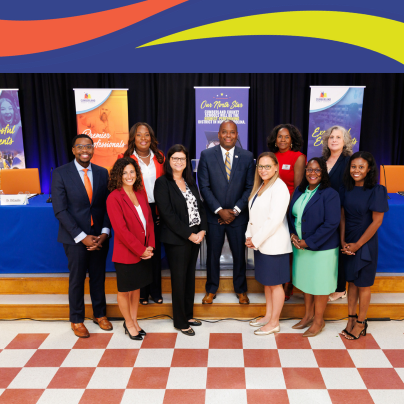
At Cumberland County Schools’ (CCS) 2025-26 School Performance Briefing & Press Conference, held on Sept. 4, four principals shared the work behind the gains: focused instruction, collective effort and students discovering what they could achieve.
Dr. Lindsay A. Whitley, associate superintendent for Communications and Community Engagement, opened with the purpose of the gathering.
“Today, we pause to take an honest look at where we stand, recognize meaningful progress and recommit ourselves to the work ahead,” Whitley said.
Serving as moderator of CCS’ 2025-26 School Performance Briefing & Press Conference, Whitley guided the audience from the districtwide results to the school-level stories behind them. The program concluded with questions from the media and a discussion of the journey ahead.
By then, the data had names, voices and stories.
Progress with a purpose
Districtwide proficiency increased from 50.8% to 55.7%, with 85.4% of schools increasing composite proficiency and 72.0% meeting or exceeding growth. CCS also reached a record-high four-year cohort graduation rate of 88.7%.
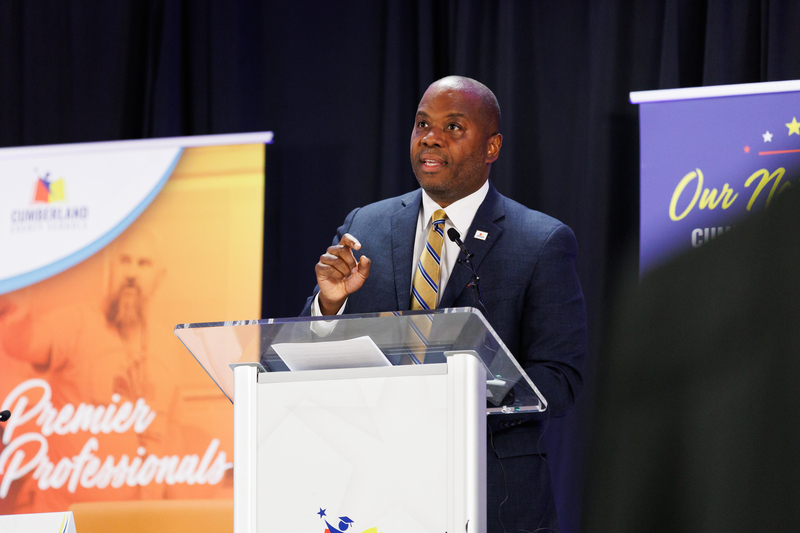
For Superintendent Dr. Eric C. Bracy, those results carried a personal meaning.
“Every number represents a name. Every data point reflects a dream,” Bracy said, recalling a belief he shared in the same room when he took the oath of office a little more than a year ago.
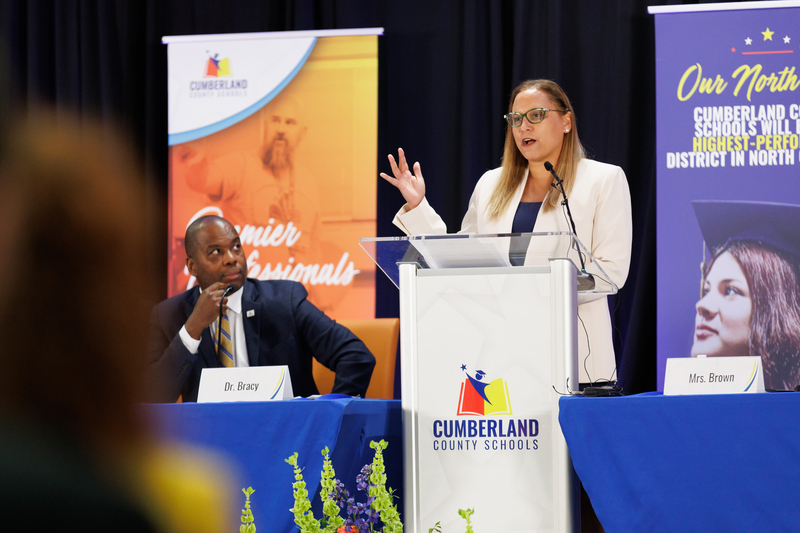
Vice Chairwoman Jacquelyn Brown brought the perspective of a retired CCS educator.
“As a retired CCS educator, this work is deeply personal to me. I understand the dedication required to help students learn, grow and succeed,” Brown said.
She reinforced the shared responsibility to strengthen outcomes across every school.
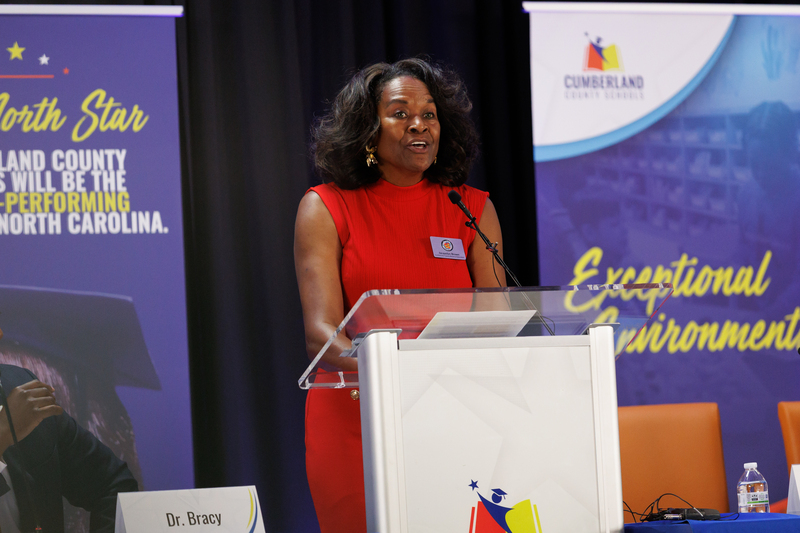
Chief Academic Officer Dr. Tonya Williams Leathers presented the detailed accountability overview before turning the focus to the people behind the results.
“The data I just shared tells an incredible macro-story, but the heart of this work lives inside our individual school buildings,” Leathers said.
Bill Hefner: A future beyond past performance
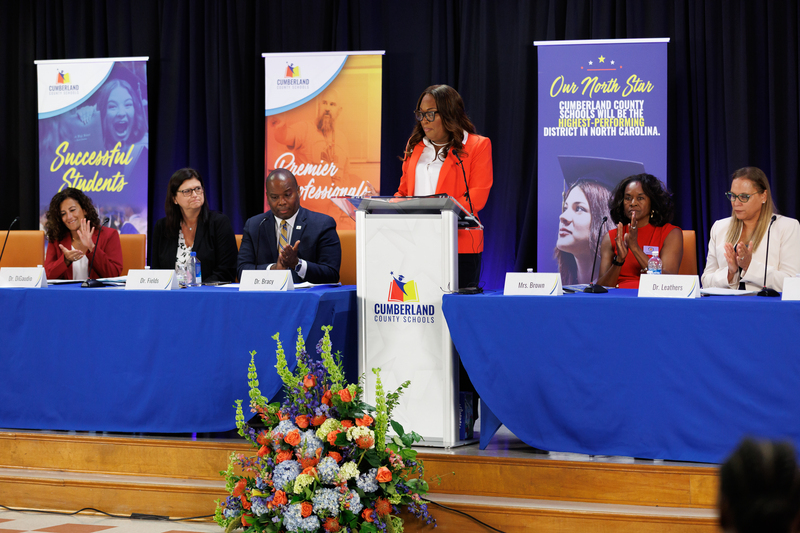
“Our past performance would not define our future progress,” said Dr. Zakiyyah Backman, principal of Bill Hefner Elementary School.
The school increased composite proficiency by 12.8 percentage points, earned an exceeded-growth rating and improved its School Performance Letter Grade from a D to a C. Fifth-grade science proficiency climbed 22 percentage points.
Backman described a team becoming “One Sound,” united around high expectations, consistent instruction and real-time data about student needs.
For her, the greatest change extended beyond assessment results: students developed the confidence to believe, “I can do this.”
Douglas Byrd: Students did the heavy lifting
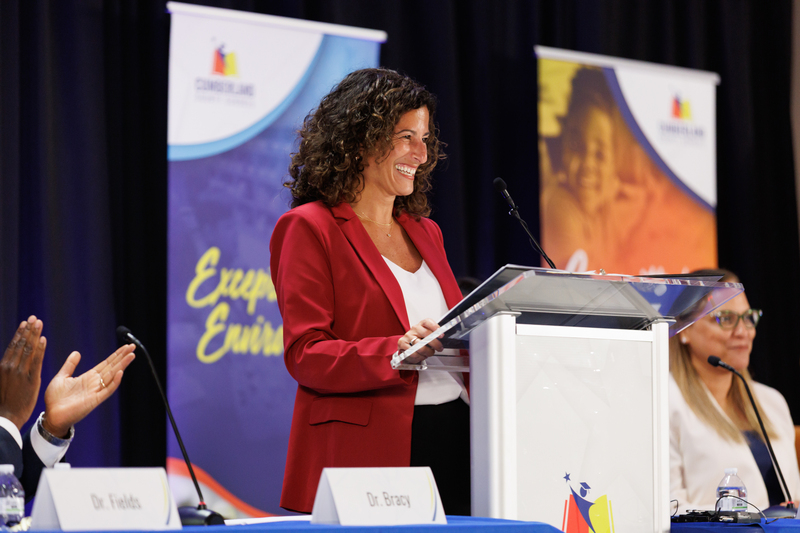
Douglas Byrd Middle School’s turnaround began with deliberate planning. Its Instructional Leadership Team used student and teacher data to shape targeted interventions. Staff adjusted schedules, modeled lessons and offered Saturday Academies and after-school tutoring.
Composite proficiency increased from 31.8% to 45.2%, a gain of 13.4 percentage points. The school earned an exceeded-growth rating and moved from an F to a C.
Principal Dr. Christina DiGaudio credited educators and staff with providing the instruction and structure—but reserved special recognition for students.
“But at the end of the day, our students did the heavy lifting,” DiGaudio said.
Some students who had never passed an End-of-Grade assessment finished the year passing all their tests. The school’s next goal: becoming a B school.
Pine Forest: Finding students sooner
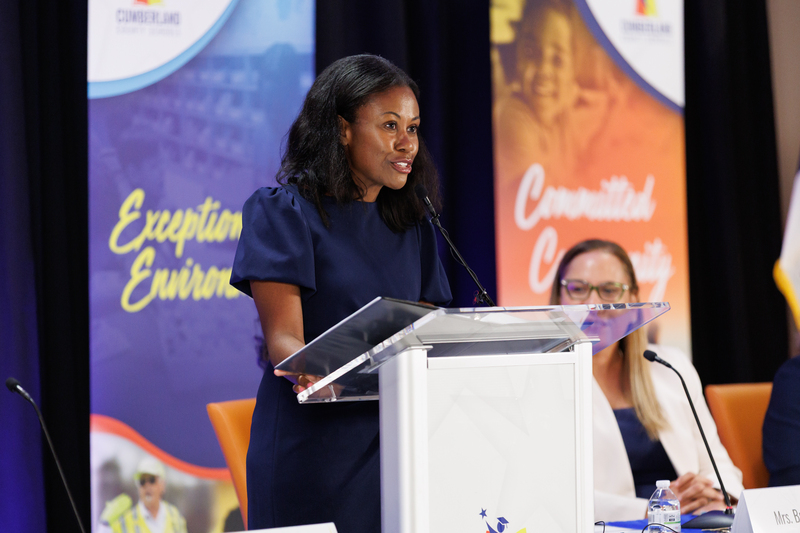
“Early in the year we made a commitment to find struggling students sooner, before a small gap became a large gap,” said Dr. Juelle McDonald, principal of Pine Forest High School.
Teachers met weekly in professional learning communities to examine assessment results, identify students individually and determine what each needed. Those conversations helped strengthen Trojan Academy, the school’s scheduled after-school tutoring program, and Exam Jam, a Saturday review session before state testing.
Pine Forest increased composite proficiency from 62.0% to 72.3%, earned the maximum converted growth score of 100 and ranked No. 2 in North Carolina for growth.
Cumberland Polytechnic: Strong achievement moving higher
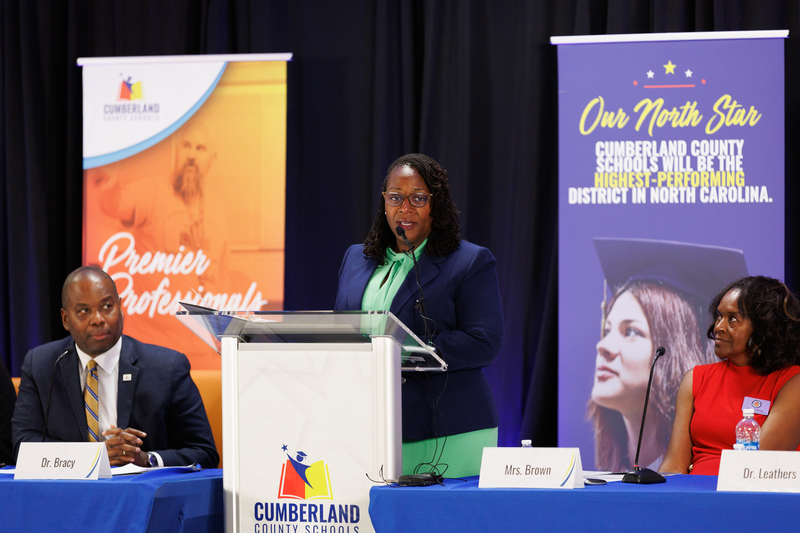 Cumberland Polytechnic High School started from a position of strength and kept pushing.
The school reached 99.3% proficiency, an increase of 5.6 percentage points. Its numerical School Performance Grade score rose from 94 to 99 while maintaining an A. It also earned the maximum converted growth score of 100 and ranked No. 9 statewide for growth.
Principal Niesha S. Witherspoon pointed to consistent instruction, rigorous assignments, targeted intervention and regular reviews of student progress—work that supports students taking high school and college courses simultaneously.
“This accomplishment truly reflects the collective effort of our entire school community,” Witherspoon said.
Four snapshots, many more stories
With most CCS principals in attendance, Bracy emphasized that the featured schools represented broader progress.
“Many principals and school teams across CCS could be on this stage because meaningful progress is taking place throughout our district,” he said.
Whitley recognized Board of Education members, members of Cumberland County’s legislative delegation and other elected officials in attendance. CCS also recognizes the support of the Cumberland County Board of Commissioners and state legislators in helping the district support students and recruit and retain educators and staff.
Turning progress into sustained performance
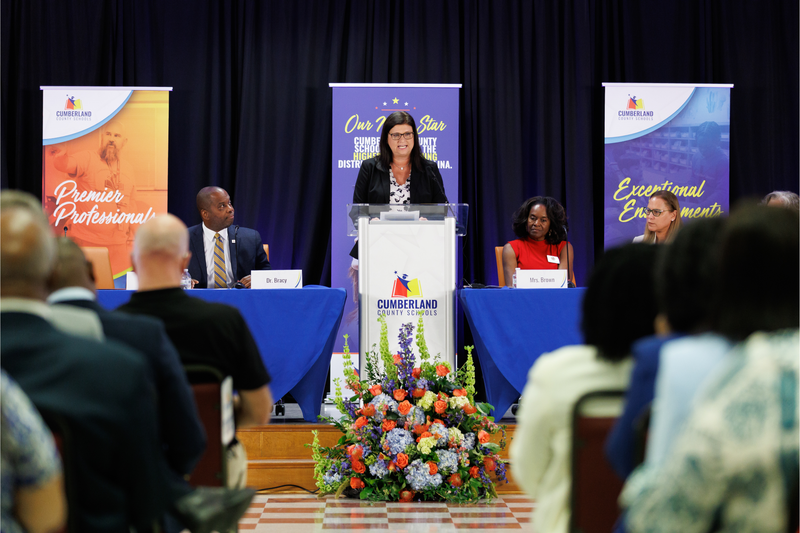
Dr. Jane Fields, associate superintendent of school support, connected the school stories to the work ahead. Her message centered on leadership that translates district priorities into daily action through high-quality instruction, student support, family partnership and alignment between schools and the district.
CCS has introduced five dedicated school support teams for 2026-27—three elementary, one middle and one high. Each principal has one point of contact for coordinated support based on the school’s data and needs.
The results provide a baseline as CCS implements its 2026-2031 Strategic Plan and pursues its North Star: becoming the highest-performing district in North Carolina.
The four principals showed what that journey looks like in practice: educators examining the data, responding to students’ needs and helping young people see new possibilities for themselves.
The Journey Continues—one student, one classroom and one school at a time.
Read the full 2025-26 Data and Accountability news release.